
Budget
Plan for accommodation, meals, transport, unexpected expenses and a reserve for rest days.
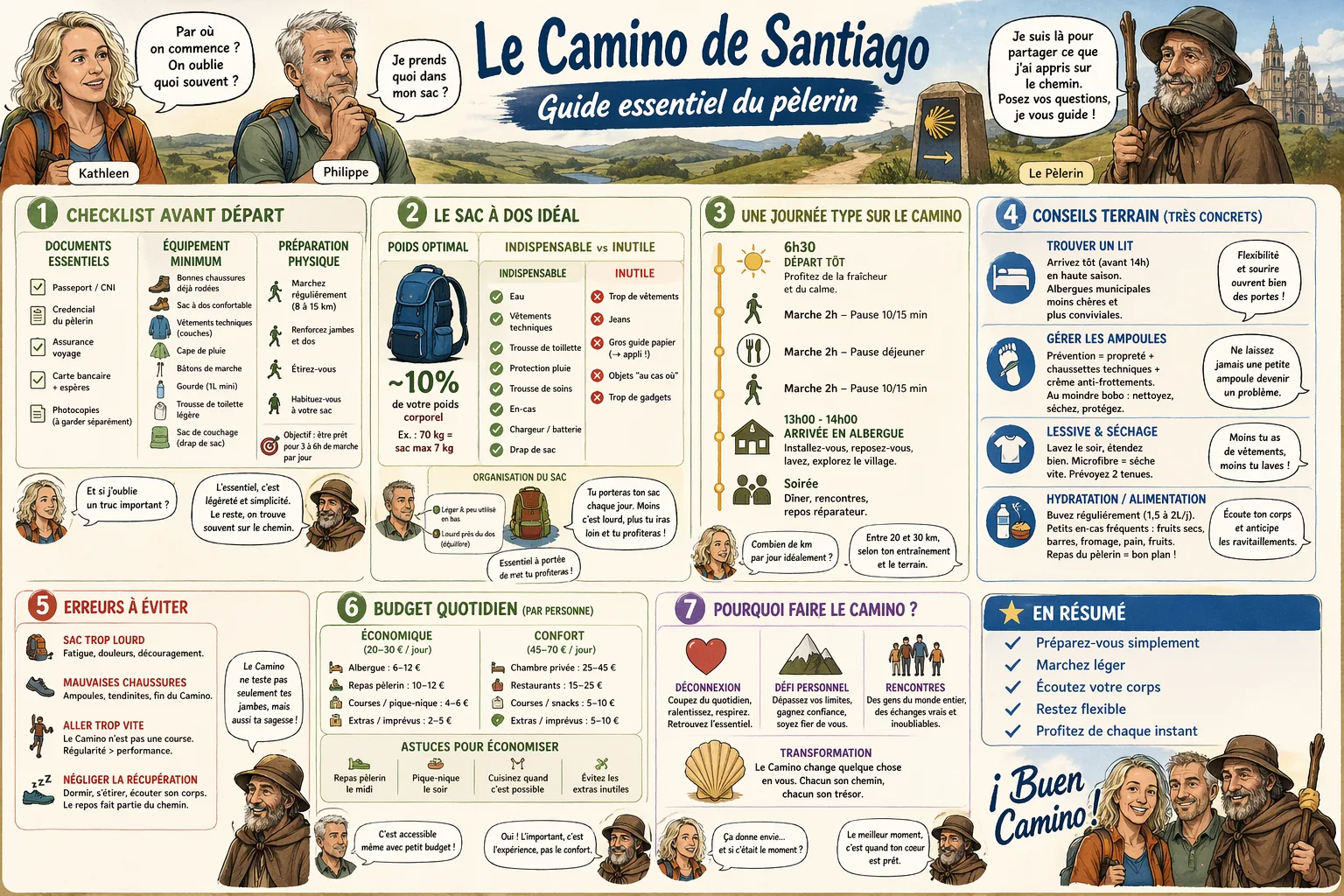
Prepare without overpacking
Our preparation notes before departure. We will add actual costs and lessons learned along the way.
Plan for accommodation, meals, transport, unexpected expenses and a reserve for rest days.
Alternate between albergues, guesthouses and private rooms depending on fatigue and availability.
Start gradually, listen to aches and keep some days shorter.
Aim for a reasonable weight and test all gear before departure.
Prepare medication, insurance, prescriptions and useful contacts without replacing medical advice.
Keep maps, bookings and contacts offline for areas with limited coverage.
About 790 km separate Saint-Jean-Pied-de-Port, at the foot of the Pyrenees, from the cathedral of Santiago de Compostela in Galicia. It is the most walked of the Camino de Santiago routes.
Most pilgrims walk it in 30 to 35 stages, about five weeks including a few rest days. We have planned 33 stages of 19 to 29 km.
Spring (April to June) and autumn (September and October) bring mild temperatures and open albergues. Summer is hot and very busy on the Meseta; in winter, the Napoleon Route over the Pyrenees is closed, as are many albergues.
Albergues, hostels reserved for pilgrims, usually cost 10 to 20 € a night in a dormitory. Guesthouses, hostales and hotels offer private rooms, often between 40 and 80 € for two.
Plan on roughly 40 to 60 € per person per day in albergues with the pilgrim's menu, more with private rooms. Add travel to Saint-Jean-Pied-de-Port and back from Santiago.
The credential is the pilgrim's passport: it is stamped every day and gives access to albergues. In Santiago, the Pilgrim's Office awards the Compostela to those who have walked at least the last 100 km, from Sarria, with two stamps a day on that stretch.
The simplest way is to fly to Paris, take the train to Bayonne, then the regional train to Saint-Jean-Pied-de-Port, about an hour away. Biarritz airport, near Bayonne, is another option.
A common guideline is no more than 10% of your body weight: every kilo counts over 790 km. We detail our choices on the Gear page.